History is complicated. Have you tried to trace someone’s lineage only to find missing information in the archival records? Or, have you heard a family story passed down orally that only certain relatives can verify? This detective work is even harder when the person comes from a culture whose history was intentionally erased. And the same is true for their languages. Take for example the word kitchen. There is one definition of the word kitchen that is unique to African American culture:
kitchen (n) – the section of hair just above the nape of your neck
Someone once explained to me that the term stemmed from the practice of styling hair in the kitchen of the house. But African Americans have a diverse past with origins in various African, European, and Native communities. When these different cultures came together, so did their languages. And this language contact led to the borrowing and transformation of each other’s words and grammars.
So, I wasn’t surprised when two of my favorite podcasts suggested kitchen might be a loanword from another language. On A Way With Words, Martha and Grant suggested it originated from the Scottish word kinch for a twist of rope or similar to a braid. On Lexicon Valley (start at 10:38), John McWhorter suggested kitchen was the Anglicization of the Kicongo word for nape which is kichin.
Both etymologies seem plausible. Scottish immigrants had an influence on the development of American English, especially in the south where many African Americans originate. Enslaved people came to America speaking languages from many regions in Africa. So which is the correct etymology? Is there some truth to both theories? Or, does kitchen have a completely different history altogether?
Want to learn more:
Kitchen isn’t the only word with a contested history. Read about the origins of mmhmm.
Can you really learn a second language from watching television? Yes. Will you develop full fluency in just a few seasons? Probably not. Diving into a thrilling TV series allows you to focus on language comprehension in a motivating context. But what you pick up from those episodes depends on your level of familiarity with the target language. Let me offer three examples from my own experience.
High Language Familiarity and Pragmatics
Spanish was the second language I learned. While my speaking proficiency is limited, I can follow simple conversations and easily recognize common words. This level of familiarity allows me to focus on pragmatics or how context influences the meaning of language.
A few months ago, I discovered two Spanish-language shows that helped me learn various ways to handle leave-taking, or what you say when you want to exit a conversation. If you asked me how to say ‘excuse me, I’m leaving’ before watching these shows, I would suggest perdón. But after following the 80-episode telenovela based on the life of salsa queen Celia Cruz, I quickly learned that con permiso was a better choice. I stored that phrase in my mind until I discovered Alta Mar (The High Seas), a drama about passengers from Spain headed to Brazil in the 1940s on a luxury cruise ship. In the middle of the second season, I noticed the characters said disculpen when preparing to walk out of a room. While I’m still unclear of when to use con permiso or disculpen, I’m now aware that different situations might require one term or the other.
Arabic is a language I never studied, but that I have occasionally heard and seen in my daily life. I can recognize when others are speaking Arabic and identify Arabic writing. This level of familiarity allows me to focus on learning high-frequency vocabulary.
Last year I watched the series Jinn, a story about high schoolers in Jordan who become ensnared in a battle between good and bad genies. The show focuses on a group of teenagers and their teacher. During their interactions, I noticed myself focusing on the referents they used to identify each other. For example, frequent scenes at one character’s home helped me learn baba (بابا ; father). Another word I picked up was habibi (حبيبي), a term of endearment. Sometimes it was used platonically between adults and youth and other times it was used romantically between the teenagers. Habibi reminds me of how we sometimes say honey or sweetie in English.
Korean is a language with which I have almost no familiarity. I rarely hear the language or see it written. I have not lived in any communities where Korean is commonly used. You may think this level of familiarity would not allow me to learn anything from watching a Korean drama, but it actually helped me focus on phonology or the sounds used to form a language.
A friend recommended I watch Vagabond, an international spy thriller where a stunt man and a National Intelligence Service officer work together to uncover the true motive behind a plane crash. Unlike the previous series I watched, I found my ear attending to the prosody of the actors’ dialogue. Just like different genres of music vary in their typical rhythms, so too do different languages. Take for example questions. In English, when we pose a yes-no question, our intonation usually rises at the end of the phrase. I of course did not know the rhythm of questions in Korean before starting the series. But, halfway through the season, I noticed that when questions appeared in the subtitles the speaker often ended them in ne or de. A quick internet search helped me learn that I was hearing the word yes (네). Yes is pronounced like ne but can sound like de because of the way Koreans sometimes pronounce the beginning sound (similar to how the t in ninety might sound more like a d as in ninedy).
Media can motivate language learning because it keeps you engaged over extended periods of time providing an immersive experience. Whether you have high or low familiarity with a language, turn on the subtitles, follow along, and you can pick up some aspect of the language. Enjoy the show!
Want to learn more? Dive into a new drama. Here are a few others I recommend:
When I began learning French in the 1990s, I carried around an arsenal of reference materials: a French-English dictionary, Le Petit Robert (a French dictionary), a Bescherelle (for verb conjugations), a notepad to store my personal vocabulary list, and a pencil and eraser for underlining and in-text note taking. Today, I can manage with just one: whatever Internet connected device I am carrying. At first glance, the resources of today seem better suited to supporting the language learner’s needs. Digital tools provide almost instant access to information that can help you understand another language. But, I’m not yet ready to abandon my printed references books.
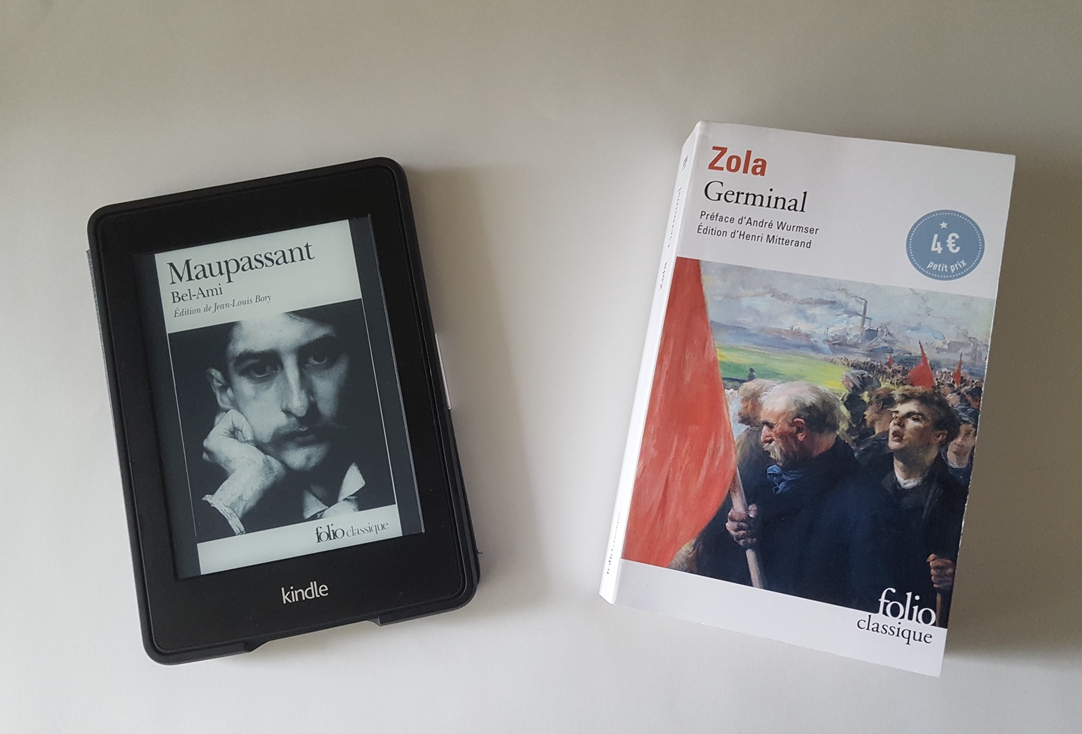
Consider these two French classics: Guy de Maupassant’s Bel-Ami and Émile Zola’s Germinal. Both were published in 1885. Both were part of literary realism, a movement that aimed at presenting the lives of everyday folk authentically. Both were on my reading list this spring. Bel-Ami was on my Kindle and Germinal in print.
Bel-Ami: the e-book Bel-Ami tells the story of Georges Du Roy, a commoner who climbs the social hierarchy of 19th century Paris through the manipulation, sometimes complicity, of multiple bourgeois women. His audacious seduction makes him the paragon of a gigolo. Georges, nicknamed Bel-Ami, both irks you with his tactics and awes you with his success. The novel was a page-turner. Nearly every scene left me shocked and thinking “No he didn’t!” I curled up with the book every night before going to bed to see what Bel-Ami was going to do next. It took me about a month to finish the 394 page story.
Germinal: the paper book Germinal tells the story of Étienne Lantier, an unemployed youth who finds community and a job in a mining village in northern France. Working under dire situations and extreme poverty, he leads the town in a violent strike against the mining company. Amid the turmoil, a love triangle between Étienne, the daughter of Etienne’s sponsor, and the daughter’s lover culminates in a somber scene when the three become trapped in the mine. Familiar with the story from Claudi Berri’s 1993 film adaptation, I was eager to read the book in French. The novel should be a page-turner. But, since starting the book in early May, I’ve only made it through four chapters of the 591 page story.
What’s taking so long?
My vocabulary gap. Many terms appearing in Bel-Ami and Germinal were specific to 19th century life, terms that I did not know. Sometimes the meaning of these words was new to me. For example, I quickly learned that une berline was a wagon used to transport coal from the bottom of a mine to the extraction pit. Other times, I needed to verify the form of a word, especially with verb tenses I never mastered (e.g., eussent, the third person plural past subjunctive form of ‘to have’). And I occasionally encountered a word usage that is new to me (e.g., crever can be used to say that a person died).
When I encountered an unfamiliar word, I turned to a dictionary for help. In reading Bel-Ami (the e-book), I simply touched a word to access multiple reference sources installed on my Kindle. In reading Germinal (the paper book), I had to move out of bed to get my dictionary, flip through the 2,000 page tome to find the word, and then read its entry until I found the appropriate definition. Where it took me less than a second to find the meaning of a word in Bel-Ami, it took me 30 seconds or more to look up a word in Germinal. Imagine going through that process for 10 words on every page across hundreds of pages…
But which approach is better?
You might say the digital version is better because I looked up more words in less time. That is, the size of words I encountered in one month with Bel-Ami is greater than the number of words I encountered in one month with Germinal. But, the depth of vocabulary knowledge with Germinal feels richer.
First, words like boisage and besonge are still floating in mind, although I haven’t picked up the book in days. So, the personal vocabulary I am developing in reading Germinal may endure longer than that of Bel-Ami.
Second, I am spending more time exploring new words in Germinal. Researchers have found that greater exposure, attention, manipulation, and time spent with a word leads to better learning of the word.
Third, the definitions in Le Petit Robert are just better than the dictionaries on my Kindle. With Le Petit Robert, I more easily identify multiword phrases and polysemous words with many definitions. The dictionary also includes authentic quotations that help me make sense of the word.
Instead of deciding which format is better, I say we harness the benefits of both digital and paper to improve the language learning experience. Here are just two ideas: (1) when a reader touches a word, the e-reader should interpret the entire sentence and make a more accurate predication of which meaning to assign to the word in that context and (2) add glosses to words the reader looked up before. If I look up voyou on page 3, underline it on all subsequent pages so I can focus on retaining that new word.
How would you improve the reading experience of second language learners?
Want to learn more about reference materials:
New General Service List: A list of the 2,800 high frequency English words that provide 90% coverage of general texts.
CNRTL: My favorite online language reference for French
Linguee.fr: My favorite online bilingual dictionary that includes many authentic examples of words used in context and their translations (available in several languages)
Motherland, fatherland, or homeland? The mothership’s maiden voyage. The forefather’s brotherhood.
Have you noticed how our words are littered with gender? Gender is even more pronounced in some languages that divide their nouns into masculine and feminine categories. For example, in French, la roue (wheel) is feminine while le pneu (tire) is masculine. Use of these categories often requires agreement with adjectives, verbs, and other parts of speech. So, if I want to talk about my new wheel or new tire I would write: la nouvelle roue or le nouveau pneu.
Categorizing nouns in this way is called grammatical gender. Not all languages employ such a system, but those that do are not consistent. For example, cake is feminine in Italian (la torta) but masculine in French (le gâteau). Some languages include a third neuter gender (e.g., das Märchen, or fairytale, German). Grammatical gender systems can extend beyond sex-based categories (think gender = genus = group). Polish distinguishes animate and inanimate objects, while Swahili has categories for uncountable nouns and objects manufactured by humans. The Fulfulde language spoken in Mali has 20 grammatical genders.
Sex-based and Non-sex-based Grammatical Gender Systems
Greville G. Corbett. 2013. Sex-based and Non-sex-based Gender Systems. In: Dryer, Matthew S. & Haspelmath, Martin (eds.) The World Atlas of Language Structures Online. Leipzig: Max Planck Institute for Evolutionary Anthropology. (Available online at https://wals.info/feature/31A#2/26.5/211.6, Accessed on 2019-03-15.)
What happens when a speaker of a non-gendered language encounters grammatical gender?
Learning grammatical gender can be difficult if you’re a native speaker of a non-gendered language. There might be general patterns that indicate when a word is assigned to one gender or another, but there are always exceptions. As a native English speaker, I often find myself guessing whether nouns are masculine, feminine, or neuter. Beyond memorizing the gender of every word — which I failed to accomplish during my coursework — there is no easy way for me to derive a noun’s grammatical group. Sometimes what you might expect is incorrect. The German word for girl (das Mädchen) is neuter. The Portuguese word for voluptuous woman (mulherão) is masculine. Gendered pronouns (e.g., him, her, she, he) can also be challenging if you’re a speaker of languages like Chinese, Turkish, or Korean with no or few gender markers. This is why you might hear someone say that Mr. Jones was washing her car when I saw him or Mr. Jones was washing car.
What happens to a sex-based grammatical gender system when views of gender evolve?
Sex is straightforward. Sex relates to biology and types of reproductive organs. Gender, on the other hand, is more subjective. We’ve already seen how gender delineates groups of grammatical classes, which differ by language. Gender can also distinguish the social roles we associate with “male” and “female”, which differ by culture. But there isn’t a one-to-one mapping between sex and gender.
Today, societies view gender as non-binary, more than just male and female. In the U.S. we use a variety of terms to distinguish our gender identities (e.g., cisgender, transgender, genderqueer). How then is this influencing our languages that were formed under a binary sex-based system? Consider the following news headlines:
In the first headline, the masculine gender term Latino is used to describe all students, regardless of gender. In many gendered languages, the masculine gender is the default used to discuss mixed-gender groups. In the second headline, À toutes et à tous addresses all females (toutes) and all males (tous). But what if you don’t identify with either group? Advocates of inclusive language are proposing new gender-neutral terms. In the early 2000s, the term Latinx appeared to replace Latino and Latina. In the 2010s, the Swedish pronoun hen appeared to replace the gender-specific hon and han. As more cultures reconsider their gendered terms, how will our languages change?
Want to learn more about language and gender:
The BBC Why Factor asks why we believe the stereotype that men and women speak differently
Germany debates removing Fatherland from its national anthem
Sometimes we communicate ideas figuratively and express our ideas through comparisons. So last week, we celebrated Valentine’s day not just with our beloveds, but also with our sweetie pies, sweet things, and honeys. Have you noticed that many figurative terms of endearment relate to sugary food? Linguists explain this similarity through conceptual metaphors that serve as a basis for the figurative phrases we create.
Conceptual metaphors are a mapping between a source domain (something understandable) and a target domain (something you want understood). We use the source domain as a lens to make sense of the target domain. Let’s take as an example the conceptual metaphor LOVE IS A JOURNEY. Our source domain is JOURNEY. Journeys involve travelers, destinations, obstacles, and decisions made at crossroads. Our target domain is LOVE. Love involves lovers, relationship goals, difficulties, and decisions made at transition points. Using our understanding of what a journey involves, we might explain difficulties in love using expressions like “I don’t think this relationship is going anywhere” or “It’s been a long and bumpy road.”
A metaphor’s meaning can get lost when translating across languages. One source of confusion is that some conceptual metaphors don’t exist in all cultures. Consider anger. In Zulu, a conceptual metaphor related to this emotion is ANGER IS IN THE HEART. This leads to phrases like:
Phrase: Inhliziyo imane yathi hluthu! Literal meaning: My heart suddenly went wrenching. Figurative meaning: I suddenly felt an upsurge of anger.
In English, however, heart is usually associated with love (you won my heart = you gained my affection) while anger is associated with things like fire or heat (he was hot under the collar = he was angry).
Another source of confusion is that aspects of conceptual metaphors can vary across cultures due to the differing worlds we live in. While JOURNEY might be a concept most people around the globe can relate to, the aspect of vehicle might depend on the modes of transportation available in our environment. A person living in a mountainous region might talk of funiculars while someone on an island might talk of ferries. These cultural variations then lead to differences in the expressions we use stemming from conceptual metaphors.
Let’s take a look again at sugary foods used as terms of endearment. One conceptual metaphor that explains the abundance of these phrases is LOVE IS APPETIZING FOOD. But what objects might we associate with the source domain of appetizing food? Chocolate? Peach cobbler? Mochi? Well, that probably depends on what you like to eat, right? Here are just a few terms of endearment I found stemming from this metaphor from different cultures:
Storybooks can serve as useful language learning aids. The text of a book reinforces vocabulary and syntax. Dialogue between characters models the appropriate ways to use language (i.e., pragmatics). So, when my friends started having children and raising them bilingually, I thought dual language storybooks would make nice gifts. And so began my foray into multilingual children’s literature. I started visiting my local bookstores to explore their inventories. All the multilingual books I found were written in two languages, English and one of a small set of other languages (i.e., Spanish, Japanese, Chinese, French, German). While I did not open every title, I only saw full-text translations where each page displayed the same text in two languages. Me Encanta Comer Frutas y Verduras – I Love to Eat Fruits and Vegetables Spanish-English is one such example.
To better understand the ways in which children express their bilingualism, I turned to François Grosjean’s 1984 classic Life with Two Languages: An Introduction to Bilingualism. In chapter 4, he summarizes research findings on the language development of simultaneous bilingual children (i.e., children who acquire two languages at the same time from birth). He notes the following:
Bilingual children code-switch (i.e., alternate between two or more languages), but how they code-switch varies as they age. Younger children code-mix where they insert individual items from one language, mostly nouns, into the other language. Older children code-change where they switch their choice of language for entire phrases or sentences.
Bilingual children code-switch for a variety of reasons, but the reasons change as they age. At the youngest ages, children code-switch to clarify comments or attract attention. As they get older, they begin to code-switch to indicate a shift in the mode of the conversation (e.g., going from narration to commentary). When they are much older, they also code-switch to indicate their connectedness to particular cultural groups.
Bilingual children might avoid words in one language that are difficult to pronounce and use the equivalent word in the second language.
Some bilingual children associate a person with one language (e.g., always speaking to grandmother in Swedish), and sometimes become upset if that expectation is not upheld. This is called the person-language bond.
With this new knowledge in hand, I returned to the store in search of storybooks that might reflect the way bilingual children use language. I found some books that used a code-mixing approach where the majority of the story was written in English and a few nouns were written in the second language and made visually distinct (e.g., through a different color or italics). One example of this is Chavela and the Magic Bubble.
I found no examples of code-switching, where longer exchanges were in the second language. Nor did I find any books that incorporated the person-language bond (e.g., the main character always interacting with grandmother in Swedish). But I’m still looking! If such books exist, I wonder whether and how they might support bilingual children’s language development differently than full-text translation books.
What are your favorite bilingual or multilingual children’s books?
Looking for more books:
storyplayr: a digital library of books in French and English for children ages 3-8. You can even record yourself reading the book so your child can hear the story narrated in your voice.
Language Lizard: an online shop with dual language books, CDs, and posters in English and one of over 40 languages
We communicate with more than words. Sometimes we use other sounds to express ideas. If someone asks, “do I really have to be there by 8am?”, you might produce a sound like mm-hmm to confirm yes. Or, if you drop your lasagna on the ground, you might produce a sound like uh-oh to indicate your mistake. These sounds are sometimes called verbal gestures as they communicate meaning but are not a part of a language’s phonemic inventory (i.e., the base set of sounds used to form words). While some of these verbal gestures seem universal, others appear restricted to certain groups of speakers. Like this one.
I use this verbal gesture to express discontent or disbelief. In fact, I do this so much at home that my partner often mocks me by exaggerating the gesture when I use it with him. After one such exchange, I paused and asked what do they call this sound in French? And then, what do I call it in English Although we were both very familiar with the gesture, neither of us could think of its name. Short of an English-French verbal gesture dictionary or a Google sound search, we reached out to some primary sources: our family and friends.
My sister-in-law identified the French term tchiper, my mother-in-law suggested piaffer, and my friend Elizabeth told me about the West Indian term of steups and the American term of sucking teeth. Then I set off to the Internet to see what else I could learn about the gesture. There are quite a few humorous videos explaining this sound (after all, doesn’t comedy offer us a reflection of society):
Comedian Samia Orosemane comments on the tchip as used by Ivorians
Gizmo comments on the steups as used by people in Trinidad and Tobago
Scholars Rickford and Rickford provide an academic viewpoint through their 1976 study looking at linguistic and cultural differences towards the gesture. Drawing upon their personal experiences in Guyana, dictionaries specific to multiple countries in the West Indies, interviews with respondents from these countries, as well as a questionnaire administered to Black and White Americans in the north east, they found that:
informants from Jamaica,Trinidad, Barbados Antigua, and even Haiti (where, we understand it is sometimes referred to as tuiper or cuiper) confirmed familiarity with this oral gesture, its meaning, and the social prohibitions against its use as outlined above…many Black Americans are also familiar with it.
About four years ago, the gesture drew attention when a few French schools decided to ban its use. Let me say that children sucking teeth at adults is an act of defiance; use of the gesture with a teacher would be rude. However, some saw this interdiction as unjust and unduly harsh towards Black students. Others considered it an appropriate way to promote the type of language expected in formal settings.
But how then do you learn to use a verbal gesture? Unlike our words, we usually don’t learn verbal gestures in formal contexts. There is no vocabulary list to study or a set of grammar rules to memorize. Yet, people still master the gesture. This gets into pragmatics, or how language is used in social contexts. For example, a person possessing pragmatic knowledge of suck-teeth knows when to use the gesture, with who, and in which settings. Take a look at Christiane Taubira, a French politician and former Minister of Justice of France, who used a mouth guard gesture after letting a suck-teeth slip out during a debate. Without formal training, we simply learn verbal gestures through immersion in a culture that includes the sounds in its communicative inventory.
What are your favorite verbal gestures?
Want to learn more:
Yaotcha d’Almeida provides a thorough explanation of the tchip gesture in French.
Lauren Cassani Davis shares her experience of miscommunication resulting from different transcriptions of verbal gestures.
If words aren’t enough, Sarita Rampersad created a steups emoji.
When multilingual speakers come together, how do they decide which language to use? Do they use the dominant language of their environment? Do they try to guess what language the other speaker is most comfortable using? Does it depend on the topic of discussion? Given the immediacy of conversation, their choices probably occur at a subconscious level and very quickly. Just the other day, I found myself in an encounter with a stranger where I made a choice to switch from English to French. It went something like this:
Pedestrian: (approaches me on San Antonio Road with a map in hand) Excuse me. Can you help me? I’m trying to find Enterprise Rental Car. Me: I’m not sure where that is. Pedestrian: It’s on San Antonio. Me: (I pull out my phone) Do you have the address? Pedestrian: (looks at a sheet of paper) Huit cent quatorze, San Antonio Road Me: Ah, vous parlez français? Pedestrian: Oui. Me: Ce n’est pas loin. C’est sur cette rue, dans ce sens là. (I point north) Pedestrian: C’est combien des kilomètres à peu près? Me: Um, ce n’est pas loin, mais vous ne pouvez pas marcher d’ici. Pedestrian: J’ai une voiture. Me: Okay, si vous continuez sur cette route, vous arriverez dans 3 ou 4 minutes. Ce n’est pas loin. Pedestrian: Merci. Est-ce que vous êtes haitienne? Me: Non, je suis américaine. Pedestrian: Oh, il y a beaucoup des haitiens près d’ici.
Let me make a few observations about this exchange:
Numbers triggered a switch in language. It was only when the pedestrian wanted to use numbers that French slipped into the conversation. He did not attempt to say the numbers in English or express them in a mix of English and French. He switched directly to French without hesitation. I sympathize with this motivation for code-switching, or alternating between two or more ‘codes’ (i.e., languages, dialects) within the same conversation. Whenever I need to count or calculate numbers, I think them through in English and then translate the result into the language of the conversation. If I hear a number in another language, I have to translate it to English to understand. It is nearly impossible for me to process numbers in another language.
Aneta Pavlenko talks about this on the blog Life as a Bilingual. In summarizing research on this topic she writes: “the language bilinguals count in may depend on the language of early schooling but the language of other numerical tasks depends on their subsequent experiences with language and math, so that some tasks may be handled faster and more efficiently in languages learned later in life.”
Seeking cultural affiliation? At the end of our conversation, the pedestrian asked if I was Haitian. After I said no, he moved on to tell me there are a lot of Haitians living in the area (which was news to me). This was not the first time that, after having a brief discussion in French, someone asked if I was from another country or another culture. In-group affiliation is another factor influencing language choice, to show that the speakers are part of the same group. So, maybe (a) he was Haitian and (b) he assumed we were both Haitian since we both spoke French.
This might also relate to what scholars call racial translation, that is positioning yourself or being positioned by others as a member of a particular cultural group. Language can play a role in racial translation. H. Samy Alim describes his personal experiences of being positioned as a member of eight different cultural groups over the span of five days as he traveled from Mountain View, CA (where my encounter occurred) to Germany. Here’s an excerpt from one of his encounters on the plane that resonates with my story:
When I told her that I spoke English, Arabic, and Spanish, with reading knowledge in Swahili, she gasped again, “Oh!” and tapped her friend Maria, the “Latina,” on the arm to bring her into the conversation. “He speaks Spanish!” Maria turned and asked me quickly, almost hopefully, “Are you Mexican?” Then, explaining her directness, she added, “I mean, how do you speak Spanish fluently?”
My mind stored the conversation in English. When I recall this conversation, I actually remember it in English. I can hear the pedestrian saying huit and vous êtes haitienne. I know half the conversation was in French. But, when I replay the episode in my mind or describe it to others, I only hear it in English. Strange, no?
This relates to two language phenomena: encoding and retrieval. Encoding relates to how we store information and experiences in our mind; retrieval relates to how we access those memories later. James Bartolotti and Viorica Marian reviewed academic research on bilingual memory and discuss how episodic memory (i.e., memories about events) may be encoded in specific languages and more easily retrieved if cued in the same language as the encoding. So, what happened with me? After the encounter with the pedestrian, I switched back to an English mindset. I started thinking of how I was going to tell my friends about the encounter, and played this in my head in English. Maybe my short-term memory processed this encounter in French, but my long-term memory saved everything in English.
When was the last time you found yourself in a code-switching or racial translation encounter?
Want to learn more:
NPR has a podcast that looks at cultural code-switching, or how people navigate their multiple worlds.
Alim, Rickford and Ball (2016) edited a book entitled Raciolinguistics, a volume of articles looking at the relationship between race and language.
Language is ambiguous. Sometimes, one word evokes multiple meanings, what linguists call homonyms. If I ask you what a seal looks like, would you describe an animal, a stamp of authenticity, or a pipe cover? It probably depends. We learn to rely on context clues to distinguish the multiple meanings of a word. So, if I ask you whether a seal looks more like a sea lion or a walrus, you will probably focus on the aquatic mammal and not the wax impression.
Confusion can arise when there is a relationship between the multiple meanings of a semantically overloaded word. For example, you can dust a cake to cover it with sugar or you can dust a table to remove a layer of particles. So, if I ask you to dust the ramekin, are you adding flour to the bowl or are you cleaning the object that was sitting in the back of the cupboard for the last ten years? Words with opposing meanings like this are called contronyms.
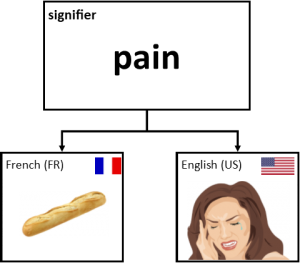
Now, add in the layer of a second language and the possibility for more homonyms and contronyms grows. In French class I learned about faux amis, or false friends. These are words that look similar in two languages but differ in their meanings. Consider pain. This word refers to a loaf of bread in French but to a state of discomfort in English.
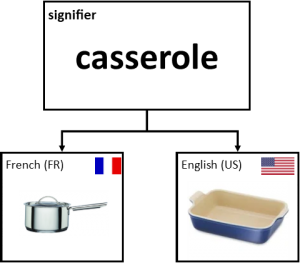
There are some faux amis that I continue to misuse because their two meanings are closely related. This is especially confusing when I find myself in a code switching situation, speaking both French and English in the same conversation. First, there is librairie and library. When speaking French, I talk of going to a librairie like Barnes & Noble or Gallimard to buy the latest novels. But, when speaking English I talk of going to the public library to borrow items for free. Then there is casserole. When speaking French, I boil water in a casserole on the stove. But, when speaking English, I put my lasagna in a casserole and cook it in the oven.
Just when I thought my troubles stopped there, I visited Cameroon and learned about the alternative uses of the word pomme. Let me set the stage. So, in French class I learned that an apple is called pomme and a potato is called pomme de terre (literally, apple of the earth).
Simple, right? Well, let me tell you what turned my world upside down. I was in a car with my in-laws driving around Yaounde when we passed a woman selling apples on the street. Someone asked if we wanted any pommes de France. Everyone said no while I sat in the back wondering if there was something special about apples produced in the land of France. A few days later, we sat at the dinner table and my mother-in-law announced we were having a stew with pommes. To my surprise, we ate potatoes. So, there you have it, apples in Cameroon are called pommes de France (literally, potatoes of the land of France) and their starchy cousins that grow underground are simply called pommes.
Since a faux amis relates to two different languages, and the French of France and the French of Cameroon might be called dialects of the same language, should this be called a fausse soeur (a false sister)?
Want to learn more:
Walter (2001) provides a classification of French-English faux amis including several examples and rationales for these duplicate meanings.











 Aleata Hubbard Cheuoua, Ph.D.